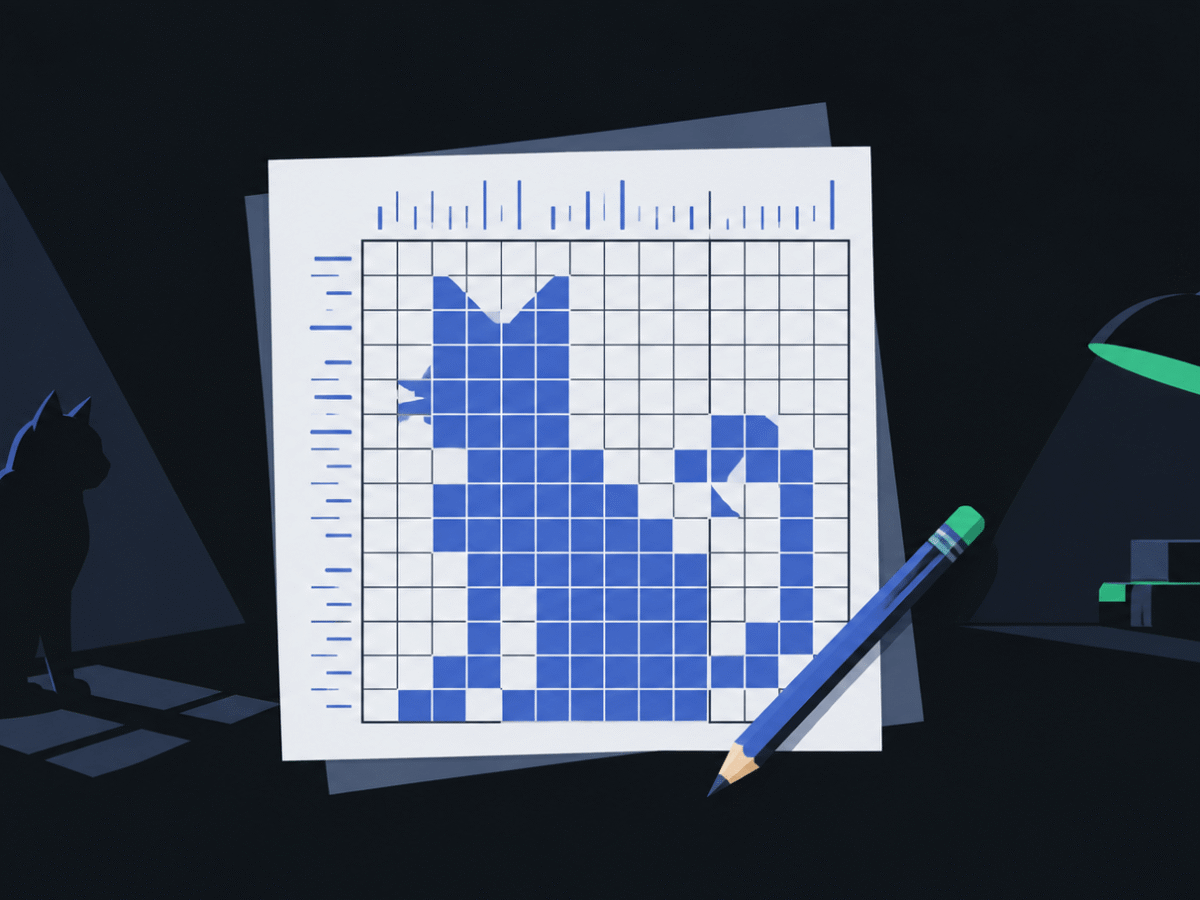
A nonogram is a picture-logic puzzle: a blank grid, a set of numbers running along its rows and columns, and a hidden picture waiting to be filled in. This guide explains what a nonogram is, how those number clues work, and the step-by-step logic that solves one without a single guess. The puzzle goes by several names — picross, griddlers, hanjie, paint by numbers — but the rules are the same wherever you meet it.
What a Nonogram Is
A nonogram is a grid whose row and column headers each carry a short string of numbers. Every number is the length of an unbroken run of filled squares, listed in the order those runs appear, with at least one empty square between them. Your task is to work out, by logic alone, which squares make up those runs. Fill the grid correctly and the shaded squares form a small picture — a cat, a key, a cup of coffee. Unlike a picture search, nothing is hidden in a scene here; the image does not exist yet, and you reason it into being one square at a time.
How the Number Clues Work
Read a clue against the length of its line. If a row is ten squares wide and its clue is a single “10”, every square is filled — there is no other way to fit a run of ten. If the clue reads “4 2”, there is a run of four filled squares, then a gap of at least one empty square, then a run of two, all in that left-to-right order. The gaps matter as much as the fills: proving a square must stay empty is as useful as proving one must be shaded, and good solvers track both.
How to Solve a Nonogram, Step by Step
Well-made nonograms never require a guess. Every square can be reasoned out, and this order keeps you moving:
- Start with the biggest clues. A clue close to the line’s full length leaves the fewest places to sit, so it gives up filled squares first.
- Use the overlap trick. Slide a run as far left as it goes, then as far right; any square it covers in both positions must be filled, whatever else happens.
- Mark the blanks. When a square cannot belong to any run, note it as empty. Cleared squares narrow the remaining runs fast.
- Cross-check rows against columns. A square you filled from a row clue may finish or forbid a run in its column. Bounce between the two.
- Fill what is forced. Work only the squares the current clues prove; leave the uncertain ones for later passes.
- Never guess. If nothing is forced, you have missed a deduction — re-read the tightest line rather than gambling.
- Complete the grid and the filled squares reveal the picture.
A Quick Worked Example
Take a single row five squares wide with the clue “3”. A run of three can start at the first, second or third square, so its exact place is not yet fixed. But slide it fully left and it covers squares one to three; slide it fully right and it covers three to five. Square three is covered both times — so square three must be filled, even before you know where the run truly sits. That is the overlap trick in miniature, and it is the workhorse of nonogram solving.
Handy Solving Habits
A few habits keep a bigger grid from feeling overwhelming. Work the most constrained lines first — the rows and columns whose clues nearly fill the space give up the most certain squares. Mark empty squares as deliberately as you mark filled ones; a clearly blocked-off square often forces its neighbours. When a run touches the edge of the grid, the edge acts like a wall you can measure from, so lines with a clue that reaches a border are a good early target. And when you finish a line, glance down every column it crosses — a single new square can unlock a chain of deductions two or three lines away.
If you ever feel tempted to guess, stop and re-read instead. A nonogram that is fair — as the ones in a good set are — never needs it. The stuck feeling almost always means a line you have already half-solved still has one forced square you have not marked.
Where Nonograms Came From
The puzzle first appeared in Japanese magazines in the late 1980s, and the name “nonogram” is widely credited to the designer Non Ishida. It reached a global audience through Nintendo’s Mario’s Picross in the mid-1990s, which is why many players still call the puzzle “picross”. Elsewhere it travelled under other names — griddlers in some papers, hanjie or paint by numbers in others — but the grid, the clues and the hidden picture never changed.
How Nonograms Compare to Other Puzzles
A nonogram is a slower, more deductive pleasure than a word search, where you hunt for words already sitting in the letters rather than reason a picture into being. It also sits apart from a seek-and-find scene: there is no busy picture to comb, only a bare grid and pure logic. If you enjoy the quiet, provable satisfaction of a nonogram, the nonogram section gathers browser grids you can play free.
Frequently Asked Questions
What is a nonogram?
A nonogram is a picture-logic puzzle played on a grid. Numbers along each row and column tell you the lengths of the filled runs in that line, and solving the grid by logic reveals a hidden picture. It is also known as picross, griddlers, hanjie or paint by numbers.
What do the numbers in a nonogram mean?
Each number is the length of a run of filled squares in that row or column, listed in order. A clue of “4 2” means a run of four, a gap of at least one empty square, then a run of two, reading left to right or top to bottom.
Do you have to guess to solve a nonogram?
No. A properly made nonogram can always be solved by logic alone. If nothing seems forced, there is a deduction you have not spotted yet — re-read the most constrained line rather than guessing.
Is a nonogram the same as picross?
Yes. Picross is Nintendo’s name for the same puzzle, popularised by Mario’s Picross. Griddlers, hanjie and paint by numbers are other names for it. The rules are identical.
Are nonograms good for beginners?
Small grids are very beginner-friendly. Starting on a five-by-five or ten-by-ten teaches the overlap trick and the row-versus-column check before you take on larger, more intricate pictures.
Where can I play nonograms free online?
You can play nonograms free in your browser — no download and no account — in our nonogram section.
Where to Start Playing
New to picross? These browser grids ease you in — open one and start reading the clues:
- Nonogram — a clean, classic grid to learn the logic on.
- Nonogram Jigsaw — solve each grid to piece a larger picture together.
- Griddlers Deluxe — a set of grids that grow with your confidence.